Zille, Phiyega face off over gangs


zilleP
Cape Town – Western Cape Premier Helen Zille and national police commissioner Riah Phiyega faced off on Tuesday over the policing of gangs on the Cape Flats.

Zille, who sat in on a provincial legislature briefing by Phiyega, confronted her about her repeated request for the SA National Defence Force (SANDF) to intervene in gang violence.

Zille said using the army to keep the peace would allow an already strained police force to gather evidence and do its job.

“Doesn’t it make sense to support a peacekeeping force of the army to come in?” she asked Phiyega.

Phiyega replied that the solution was not that simple.

“The issues you are raising, premier, we must talk about sustainable solutions,” she said.

“Until we get to the point where we start talking about sustainable intervention to look at the root causes of the problems… we will continue in the process we are continuing.

“The issue of drugs and gangs is not just a policing matter, it is a socio-economic matter. It requires that we all intervene.”

Phiyega said the police were up to the task of protecting drug and gang affected areas.

She said it was because of the police that children had been able to return to 12 Manenberg schools, which were recently closed for two days because of gang violence.

“Our jails are full because police are doing their work. Large sentences are being passed because police are doing their work.”

Addressing the problem

Mark Wiley, chairperson of the standing committee on community safety, corrected Phiyega about her jail comment, and said prisons were overflowing, especially Pollsmoor Prison, because of a backlog in awaiting trial detainees.

Zille said she agreed with Phiyega that various bodies were responsible for addressing the root causes.

The Western Cape government had spent R84m on addressing substance addiction and abuse, she said.

However, she disagreed about the Manenberg schools issue, and said children had been able to return only after the provincial government took R6m from the education budget and diverted 71 metro police officers.

“That wouldn’t have been necessary had SANDF helped with peacekeeping patrols,” Zille said.

She questioned whether the commissioner’s reason for not deploying the army was based on research.

Phiyega said parties should be careful to not politicise or personalise the issue at hand.

“As the police, our duty is to serve the nation and we use all information and data around us to design our service. We are not politicians, we are pure service providers for the nation,” she said.

– SAPA
SA must learn from Malaysia – Zuma


zuma
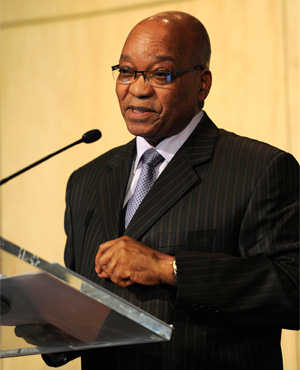
Johannesburg – South Africa has much to learn from Malaysia’s investment in education, President Jacob Zuma said during an official visit to Malaysia on Tuesday.

“Malaysia has done very well through investment in the development of its people through education,” Zuma said.

“[The country] is well on the path of becoming a developed country within the time frame it has set for itself, and you have recognised quality and inclusive education as a crucial contributor to achieve this remarkable goal.”

Zuma received an honorary doctorate of leadership from the Limkokwing University of Creative Technology on his two-day visit to the Southeast Asian country.

The president said South Africa had made substantial progress in reforming education post-apartheid.

“Government’s commitment to education is witnessed by the fact that education is allocated 20% of total state expenditure, receiving the largest share of government spending,” Zuma said.

The international relations department said 2013 marked the 20th anniversary of formal diplomatic relations between the two countries.

It said South Africa was the largest African investor in Malaysia, with investments in the petro-chemicals, insurance, food, and beverages industries.

Total trade between South Africa and Malaysia grew from about R13.8bn in 2008 to R19.7bn in 2012.

Zuma thanked the people of Malaysia and its leaders for the role it played during the anti-apartheid struggle.

– SAPA

SAPS Marikana info ‘inadequate’


Farlam+Commission
Pretoria – The SAPS has provided inadequate information to the Farlam Commission of Inquiry into last year’s shootings at Marikana, the commission was told on Tuesday.

“The SA Police Service [SAPS] has provided the commission with inadequate statements, which we have to rely on,” Michelle Le Roux, for the SA Human Rights Commission (SAHRC), said.

“They and the miners know exactly what happened… it is unfortunate that the other party [miners] is not here.”

Le Roux had asked North West deputy police commissioner William Mpembe where he was and at what time he heard about the shootings on 16 August.

Mpembe could have known about the shootings much earlier, judging by the police radio communication traffic, Le Roux said.

Mpembe said he was not at the scene during the shooting.

“I heard about the shootings over the radio in my hand, as I was heading to board a helicopter.”

Commission chairperson, retired Judge Ian Farlam, told Le Roux she would get co-operation from police if she needed more material.

The final report by the commission would not be one-sided.

“Regarding persons who are absent, their versions will be brought before the commission by evidence leaders, who can also call on witnesses,” Farlam said.

“To suggest that the report and findings would be one-sided and based on police information is unfounded.”

The commission is investigating the deaths of 44 people killed during strike-related unrest at Lonmin’s platinum mining operations at Marikana, near Rustenburg in North West, in August last year.

Police shot dead 34 people, almost all striking mineworkers, on 16 August 2012, while trying to disperse and disarm them.

Ten people, including two police officers and two security guards, were killed in the preceding week.

– SAPA

Matric marker tests deferred


ac0a2b4529654e67bcfefde1a64d2ba2
Cape Town – Not all those marking this year’s matric exam papers will have sat a test to demonstrate their competence, according to Basic Education Minister Angie Motshekga.

“Not all the provincial education departments will implement the competency test for markers in 2013, as initially planned,” she said in a written reply to a parliamentary question, tabled on Tuesday.

The reason was she had not yet approved a policy on administration of such a test, due to the need for further consultation with one of the teacher unions that had opposed the writing of the competency test.

Her reply does not name the union, but later refers to it as the country’s “major” teacher union.

The largest teacher union in South Africa, with 240 000 members, is the SA Democratic Teachers’ Union (Sadtu).

Motshekga said she would meet the union to address their concerns and finalise the policy.

“However, given that most of the [provincial education departments] are at an advanced stage of appointing their markers for the 2013 National Senior Certificate examination, the official implementation of the competency test will be scheduled for 2014,” she said.

– SAPA

Durban rugby death case back in court


justice-logo
Durban – A rugby fan beaten to death outside Durban’s Kings Park Stadium may have been involved in more than two fights on the fatal night, the Durban Magistrate’s Court heard on Tuesday.

Prosecutor Krishen Shah said information had been received that former Royal Marine Brett Williams might have been involved in another altercation prior to the two clashes he had with the five men accused of beating him to death.

This information needed to be investigated, he said.

Apart from the new information, the case against the five accused was “98% complete”.

Four of the men – brothers Blayne and Kyle Shepard, Andries van der Merwe, and Dustin van Wyk – face one charge of murder, three of assault with intent to commit grievous bodily harm, and one of crimen injuria.

A fifth accused – Grant Cramer – is charged with one count of assault with intent to cause grievous bodily harm.

Williams, 29, was killed at a Super XV match in Durban in March.

Bail conditions

Magistrate Vanitha Armu relaxed the men’s bail conditions. They no longer had to report weekly to a police station near their homes.

The four facing murder charges are out on bail of R5 000 each, while Cramer is out on bail of R2 000.

At their appearance in June, Shah said Williams allegedly had an altercation with Cramer outside the stadium on the night of 23 March.

Cramer “had a choke hold” on Williams, and he lost consciousness, Shah told the court.

Paramedics revived him, but the other four allegedly “kicked and punched” him in a second altercation later.

Paramedics were unable to revive Williams again, and he was declared dead at the scene.

Armu postponed the case to 8 October for a pre-trial conference, by which time the State should have provided the legal teams with all the evidence against their clients, and possibly for a trial date to be set.

It still has to be decided whether the case will be heard in the regional or high court in Durban.

– SAPA

Prison population at 156 000


crime_scene
Cape Town – The latest figures show there are more than 156 000 inmates in prisons around the country, more than a quarter of whom are awaiting-trial prisoners.

“As at 20 August [this year], there are a total of 156 370 inmates in our correctional facilities, of which 112 416 are sentenced offenders, and 43 954 are remand detainees,” Correctional Services Minister Sibusiso Ndebele said.

In a written reply to a parliamentary question, tabled on Tuesday, he said his department was committed to reducing overcrowding in its facilities.

“The [department] committed itself to reduce the level of overcrowding by at least 2% per annum in order to comply with the constitutional requirement to detain inmates under humane conditions.”

Ndebele said correctional services had managed to reduce overcrowding in prisons from 38% in 2007/08, “to 28% as on 30 July [this year]”.

– SAPA

ANC councillors register independently


anc-logo
Johannesburg – Eight of the 14 Tlokwe councillors who were expelled from the ANC last month have registered independently with the Independent Electoral Commission (IEC), The Star reported on Tuesday.

The newspaper reported that on Monday the eight councillors registered in Mahikeng, North West, for the by-elections in Potchefstroom on 18 September.

The councillors’ expulsions were overturned on Saturday by the ANC’s national disciplinary committee.

Former ANC chief whip in Tlokwe David Kham reportedly told the newspaper on Monday night that he was one of the eight people who had registered as an independent candidate.

“Yes, eight of us met the IEC deadline to register as candidates. I am done with the ANC,” Kham was quoted as saying.

North West IEC electoral officer Tumi Thiba told the newspaper the candidates’ names would be made public after the IEC conducted quality assurances on Tuesday on the documents provided.

– SAPA

Marikana attack ‘sparked’ by teargas


Farlam+Commission
Pretoria – Teargas fired by a police officer sparked an attack by miners that resulted in the deaths of two officers and three other people at Marikana last year, the Farlam Commission of Inquiry heard on Tuesday.

North West deputy police commissioner William Mpembe said Warrant Officer Kuhn had fired teargas at protesting mine workers on 13 August 2012, but he was unaware who had instructed Kuhn to do so.

Michelle le Roux, for the SA Human Rights Commission (SAHRC), asked Mpembe if he had informed provincial commissioner Zukisa Mbombo about the incident.

“I told the provincial commissioner, and that Kuhn himself could not say who he got the instruction from,” he replied.

The commission is investigating the deaths of 44 people killed during strike-related unrest at Lonmin’s platinum mining operations at Marikana, near Rustenburg in North West, in August last year.

Le Roux said it was surprising that Mbombo had not mentioned the teargas during a media briefing on 16 August.

“The SAHRC will submit that during her media briefing, the provincial commissioner did not seem to take into account the use of the teargas on 13 August.

“She said ‘all of a sudden they [protesters] advanced towards the police and two officers and three members of the public were killed’,” said Le Roux.

She asked Mpembe why Mbombo had not mentioned the teargas incident.

“There should have been notes made on that… but I do not know how that came about,” he said.

– SAPA

Cape Town braces for bad weather


33de48d8db0c40778aad67c2d0a3ebe7
Cape Town – The City of Cape Town has warned the Mother City will experience cold and wet weather conditions for the next few days, a city official said on Tuesday.

“The weather warning issued indicates that heavy rain is expected over the Cape Metropole overnight on 27 August and 28 August 2013,” disaster and risk management spokesperson Wilfred Solomons-Johannes said.

A cold front was due to set in, bringing very cold and wet conditions accompanied by gale-force north-westerly winds between Cape Point and Cape Agulhas.

“We urge resident to exercise caution,” he said.
Sapa

No confidence ruling: DA wins the war


Court
Johannesburg – Democratic Alliance leader Helen Zille said the Constitutional Court’s finding that Parliament must correct its rules within six months to allow for a no confidence debate was a victory.

The Constitutional Court dismissed an application by the DA to compel Parliament to debate a vote of no confidence in President Jacob Zuma.

The ANC said in a statement that this was a triumph for itself.

However, the court also ruled that rules regulating the Assembly were inconsistent with the Constitution and invalid.

“The rules of the Assembly must permit a motion of no confidence in the president to be formulated, discussed and voted for… within a reasonable time,” he said.

‘Correct the defect’

The court ordered that Assembly “correct the defect” in its rules so that members or political parties could debate a motion of no confidence. Parliament was given six months to do this.

Zille tweeted after the ruling: “This is a victory for the DA: once the rules are changed, as [the] ConCourt requires, then the DA will be able to bring a no confidence motion.”

The DA’s parliamentary leader Lindiwe Mazibuko also tweeted that once the rules had been changed, an MP will be able to bring a motion of no confidence without ANC hindrance.

DA chief whip Watty Watson told reporters the opposition was vindicated by the court order that Parliament remedy the absence of a rule on no confidence within six months.

“This was the principle we believed was worth fighting for and we are vindicated in our belief… today was a victory for our constitutional democracy and the right of Parliament to hold the executive to account.”

But ANC chief whip Stone Sizani said the case should never have been taken to court, and the ruling party read the outcome as a victory for the democratic separation of powers.

“The judiciary should not be placed in an uncomfortable position of interfering in internal affairs of an independent arm of the state, unless so directed by the Constitution,” he said.

Deputy Chief Justice Dikgang Moseneke said according to Parliament’s rules, Speaker Max Sisulu did not have the power to schedule a motion of no confidence in Zuma.

“…The Speaker acting alone has no residual power to schedule a motion of no confidence in the president to be debated and voted on in the Assembly, and that in any event the relief sought in the appeal has become moot.”

No consensus reached

Moseneke said the primary purpose of a motion of no confidence was to ensure that the president and the national executive were accountable to the Assembly.

Mazibuko, supported by seven other opposition parties, tabled a motion of no confidence in Zuma in the Nationl Assembly on 8 November.

However, Sisulu later adjourned a programming committee meeting without the debate being scheduled, on the basis that no consensus had been reached.

The DA took the matter to the Western Cape High Court where it was dismissed by Judge Dennis Davis.

Davis ruled that it was any MP’s right to request a no confidence debate, and that such requests were “by their very nature” urgent.

Parliamentary rules

But, because the Assembly’s rules did not provide for no confidence debates, Davis could not tell Sisulu when and where the debate should take place.

The high court held that Parliament had the obligation to give effect to the right to debate and vote on a motion of no confidence, but that only the Constitutional Court could hear this matter.

It was argued by Mazibuko’s lawyer in the Constitutional Court in March that the high court erred in finding that the Speaker did not have the power to schedule the motion in the event of a deadlock in the programme committee.

Mazibuko submitted that the Assembly rules were inconsistent with the Constitution.

The DA said it was now up to Mazibuko to decide whether she wanted to reintroduce the motion of no confidence in Zuma and she was currently abroad.

“I can’t say what Lindiwe will do but the reasons for bringing the motion in November last year are as valid, even more valid, today,” Watson said, citing the growing controversy over millions spent on security upgrades at Zuma’s home in Nkandla, in KwaZulu-Natal.

– SAPA