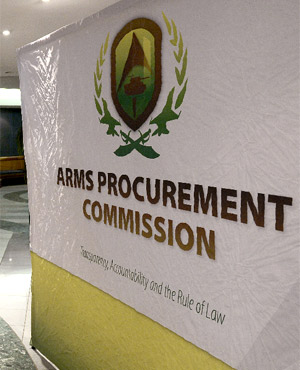
Pretoria – South Africa’s military force design was very modest in 1998, a senior SA Navy officer told the Seriti Commission of Inquiry on Tuesday.
“From the look of it, it was a very modest force design in terms of the size of the country,” Rear Admiral Alan Green said in Pretoria.
“Now whether there is a threat or not, as long as there’s a mandate for us to have a national defence force… It is the role of that department to indicate how it intends achieving that and that’s what the department did.”
The execution of this, however, relied on funding which was not determined by the defence department.
Green was testifying on the rationale of the multi-billion rand arms deal and the utilisation of the equipment acquired.
He was the first witness to testify in the initial phase of the commission’s public hearings into the strategic defence procurement package.
President Jacob Zuma appointed the commission in 2011 to investigate alleged corruption in the 1999 arms deal.
Spending
Evidence leader Tshepo Sibeko asked Green about comments made that South Africa did not need to spend so much money on arms as it was not at war at the time.
Green said anything less than the core force that was decided on would have made it difficult to expand on if the need arose.
“When we say there’s no clear threat, I don’t believe we should be nave of the possibility of a threat arising in the medium term,” he said.
“Therefore, we need to have a core force.”
He said capabilities, especially submarines, could not be developed in the medium term.
“It’s a long-term programme, we’ve had experience of that. We knew how long it took us to establish our submarine capability, the greatest deterrent in the maritime environment.”
The large ship capabilities with the frigates also took a long time. It was a developmental process. People needed to be trained, said Green.
A platform needed to be developed for future growth.
He said a defence posture was meant to be a deterrent.
“By having a vessel in the harbour, one is executing the deterrent factor.”
It was easier to “ramp up” the army than the navy or air force.
“Had we expressed that force design as is… We would have had no capability, whatsoever, to defend and protect,” said Green.
– SAPA
 The Guardian