ANC North West removes councillor’ speaker


Image

Mahikeng-Councillors of the ANC-run Ngaka Modiri Molema district municipality in the North West have removed speaker Tebogo Ramashilabele.


“We are going to have a meeting with the councillors [on Friday] to get their side of the story so we can determine what the situation is,” ANC spokesperson Ishmael Mnisi said on Friday.


The Democratic Alliance in the municipality, which has its seat in Mahikeng, said it walked out of a council meeting on Thursday because it was clear it was focusing on “ANC factional interests driven by power hungry individuals”.


“We will not assist the ANC in their disruptive internal battles,” DA councillor Jacqueline Theologo said.


“Due to the inquorate council all decisions made in council would be deemed unlawful.”


This is the second municipality in the North West where African National Congress councillors have unseated one of their own.


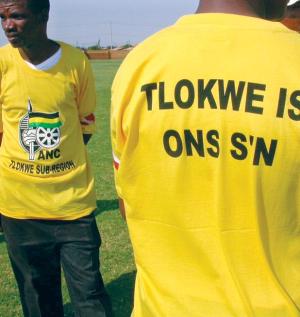
ANC councillors voted to unseat Tlokwe mayor Maphetle Maphetle last week. On 2 July, DA councillor Annette Combrink was voted in as the new mayor, for the second time since November, unseating Maphetle.


On 3 July, the North West ANC’s provincial disciplinary committee expelled 14 of its councillors who voted him out.


However, the ANC is adamant that Maphetle remains Tlokwe mayor because it claims the council meeting, where he was unseated, was unlawful.


The party had applied to the High Court in Pretoria for it to declare the meeting illegal. 

SAPA

Miners, Unions in a tough wage talks


Image

Johannesburg – South African mining unions and gold companies started wage talks on Thursday billed as the toughest since the end of apartheid, with demands for a doubling of basic pay set against collapsing bullion prices and shrinking profit margins.


The two-yearly negotiations normally take two months but this year’s talks are expected to drag out because of a vicious union turf war that sparked strikes last year in which producers lost billions of rands of output and some workers were killed.


“For us it’s about finding the balance between what is affordable and what the employees want,” said Elize Strydom, a senior executive at the Chamber of Mines, which represents firms employing 120 000 of the gold sector’s 140 000 workers.


This year the Association of Mineworkers and Construction Union (Amcu), which represents 17% of the gold workforce according to the chamber, will join more established unions such as the National Union of Mineworkers (NUM) for the first time.


Amcu’s clashes in the last 18 months with ANC ally NUM, historically South Africa’s most powerful union, have destabilised labour relations in the mines and across the economy.


Amcu has emerged as the dominant union in the platinum sector and its demands for gold mining companies to more than double the wages of entry-level workers forced NUM – normally a more conservative negotiator – to up the wage ante as well.


Coal industry wage talks will be conducted in parallel with those of gold but are likely to be far smoothe, with the Amcu-NUM rivalry not as evident in the sector.


Although nobody expects a settlement anywhere near Amcu or NUM’s demands, analysts doubt whether an industry in terminal decline can afford increases much above inflation, currently at a shade under 6%.


“They’re likely to settle about 3% above inflation but even 10% will hurt,” said David Davis, a gold analyst at SBG Securities in Johannesburg.


From its zenith in the 1970s, when South Africa was digging up 1 000 tonnes of gold a year, the country produced just 167 tonnes in 2012 – a consequence of the need to “chase the reef” ever deeper into the bowels of the earth.


South Africa’s mines operate at 4 km or more underground, a depth that imposes huge costs on companies that have also had to swallow a 25% fall in the bullion price since January as well as a sharp increase in the price of electricity.


A weaker rand, which lowers local costs, has given them a temporary lifeline but the industry argues that an overly generous wage settlement is unaffordable and will only result in job losses – something the ANC is loath to see less than a year before an election.


“Affordability is key because if we do not take that into account in the long run it will jeopardise work security,” Strydom said.


“It will jeopardise the life of the mines and it will be bad for the country because mining is still a key industry in South Africa.”


Despite steadily declining output, gold remains an important element of South Africa’s economy, accounting for 10% of all exports in 2012.

For more http://www.news24.com
SAB League National Champs strikers excite Petersen


Image

Legendary South African marksman Calvin Petersen was suitably impressed by the talent on show at the SAB League National Champs.


The tournament is currently taking place in Stellenbosch, with the semi-finals underway on Friday (12 July 2013)– both kick off at 10h00 at the Idas Valley Stadium as Western Cape take on KwaZulu Natal, while Mpumalanga will clash with Limpopo.


Former Moroka Swallows and Durban Bush Bucks striker Petersen is at the tournament as part of the Castle Lager SuperStars XI scouting and talent identification project which has been ongoing for around eight months now.


This has seen an all-star team of professionals including Neil Tovey, Phil Masinga, John Tlale, John “Shoes” Moshoeu, David Nyathi and Petersen seeking to identify the cream of the crop in terms of young players shining in the SAB Leagues across the country.


In January this year a select group spent time together in camp in Stellenbosch (at the Stellenbosch sports Academy) and the High Performance Centre in Pretoria.


Friendly matches were played against Ajax Cape Town, Vasco da Gama, University of Pretoria, Cosmos and SuperSport United, with PSL and NFD coaches there to hunt for talent.


Petersen and the rest of his team are now hoping to uncover a few additional gems at the 2013 SAB League National Championships, and he is pleased with what he has seen over the last three days.


“I’m very excited – it’s a great initiative by SAB, where young players get exposure and where they have an opportunity to be seen by scouts, to maybe go on and play in a professional set-up in the PSL or the NFD.


“It has been very impressive, there have been quite a few players I think are good enough to go and play in one of the top divisions, because from what I have seen the standard is quite high this year,” he said.


As a respected and successful front man in his own playing days, Petersen has being paying special attention to the strikers on display at Idas Valley and has some advice for the youngsters.


“There are quite a few strikers here that I think could be goal scorers at the highest levels. But some of them are quite raw. They need to learn where to make their runs from, how to run off the ball, how to position themselves, their composure, getting into the box, allowing the midfielders to do their job.”


Sascoc sues a journalist R21.1m for defamation


Image

Johannesburg – The SA Sports Confederation and Olympic Committee (Sascoc) has instituted a defamation claim of R21.1 million against sports journalist Graeme Joffe in the High Court in Johannesburg, Beeld reported on Friday.


The court documents, filed on July 3, argued that 23 of Joffe’s sports columns, written for, among others, Media24, were defamatory, and that Joffe had accused the organisation of unethical and illegal conduct.

According to the court papers, Joffe wrote that Sascoc had behaved “contrary to the interest of South Africa, engaged in corrupt activities, and wasted money”.


Eight of Sascoc’s board members, including the organisation’s president Gideon Sam, and chief executive Tubby Reddy, lodged the claim.


The plaintiffs said they would argue in court that what Joffe wrote was inaccurate and that he intended to harm their reputation.


The eight had also demanded that Joffe withdraw his statements and apologise.


Joffe said in response that as a sports journalist, he had an obligation to tell the truth about Sascoc, that the organisation bullied many people, and that this was in all likelihood an attempt to silence him.


“I will definitely oppose the claim.”


He stood by everything he had written, and he had all the facts to substantiate his claims, Joffe said.


SAPA