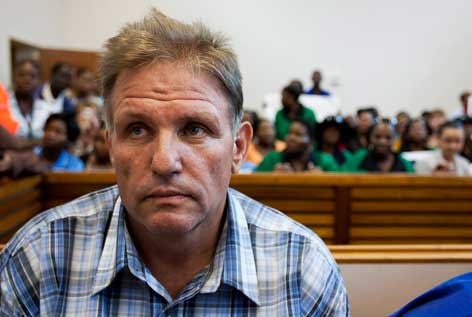
Pretoria – There was no evidence that Johan Kotzé knew that his co-accused was HIV positive, the North Gauteng High Court in Pretoria heard on Thursday.
“Modimolle Monster” Kotzé should be convicted of attempting to murder his ex-wife because one of her rapists was HIV positive, the State argued in court.
Although there was no evidence that Kotzé knew that his co-accused Andries Sithole was HIV positive, the possibility of HIV transmission was very real, prosecutor Retha Meintjes argued.
“He [Kotzé] had the direct intention and in fact hoped she would contract HIV, although there was no evidence that he knew of Sithole’s HIV status.
“There was also evidence that Mrs [Ina] Bonnette could have died from shock,” Meintjes said.
Meintjes argued Kotzé and Sithole should be convicted of premeditated murder, and kidnapping, raping, attempting to murder, assaulting, and sexually assaulting Bonnette.
She said Kotzé carefully planned and executed the 3 January 2012 attack on his then wife Bonnette and her 19-year-old son Conrad.
Bonnette earlier testified how Kotzé sexually and physically tortured her and cut off her nipples before Sithole, Pieta Mohlake, and Sello Mphaka raped her.
She was forced to listen to her son pleading for his life before Kotzé shot him three times while she lay gagged and tied to a bed.
Meintjes conceded the State had not proved that Mohlake and Mphaka were aware of Kotzé’s plans to murder Conrad.
She, however, asked for their conviction on the charges of kidnapping, repeatedly raping, attempting to murder, assaulting, and sexually assaulting Bonnette.
She said Mohlake and Mphaka knew well in advance that she would be raped and were willing participants.
‘Caravan washing’
The term “caravan washing” was in fact a way of describing their plans to rape Bonnette, she said. Kotzé had apparently hired the three to wash his caravan at his home in Modimolle, where the crimes were committed.
“There was indeed a conspiracy between all of the accused to commit the deeds with Mrs Bonnette and they all had a common purpose.”
Meintjes said the defence psychologist who testified that Kotzé could not be held accountable for his actions, because of a state of dissociation was subjective and based her findings on Kotzé’s version of events.
She argued that the psychologist’s evidence should be rejected in favour of the State psychologist’s evidence, who testified that Kotzé was fit to stand trial.
“He planned it carefully in advance and executed deliberate and planned actions,” she said.
“They were in the circumstances reckless in the sense that they did not care if she contracted the virus or not… In Kotzé’s case, where he harboured particular ideas of revenge against Bonnette and went to the trouble of getting people to rape her, he was totally reckless.”
The trial continues.
SAPA
 The Guardian