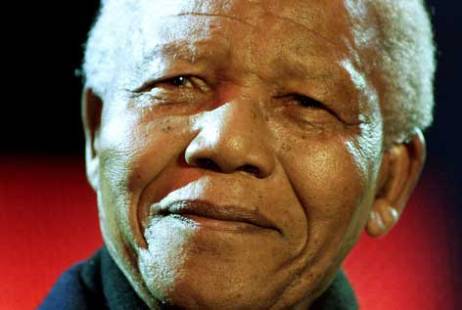
Johannesburg – Nelson Mandela, in the twilight of life, doesn’t talk much anymore, his eldest daughter says.
But the former South African president, who wrote of his regret at being unable to devote himself to his family during the fight against apartheid and afterward, reaches out in another way.
“It’s the hand that he stretches out. It is the touching of the hand that speaks volumes for me.
“And for me, if you ask me what I would treasure, it is this moment that I treasure with my father,” said Makaziwe Mandela, the oldest of Mandela’s three surviving children, all daughters.
“It means, ‘My child, I’m here.’ It means to me that, ‘I’m here. I love you. I care.'”
It could be the story of any family, this intimate encounter between an elderly parent beset by illness and a child with whom relations have, over many decades, been challenging or negligible.
That their communication has become so elemental also sheds light on the fragile state of a larger-than-life figure, revered for his sacrifice during 27 years as a prisoner of apartheid and his peacemaking role in the country’s shift to a democracy inclusive of all races.
“My dad has not been in good, perfect health over the past month. And he has good days and he has bad days,” Makaziwe Mandela said in an exclusive interview with The Associated Press in her home, where a bust of her father, made from bronze and the wood of a railway tie, sits on a piano in the foyer.
One of those bad days was 29 April, when state television broadcast footage of a visit by President Jacob Zuma and other leaders of the ruling African National Congress to Mandela, who had helmed the ANC, at his Johannesburg home.
Zuma said Mandela was in good shape, but the footage – the first public images of Mandela in nearly a year – showed him silent and unresponsive, even when Zuma tried to hold his hand.
Makaziwe Mandela said her family is grateful that the “movement”, as she refers to the ANC leadership, still visits her father.
The broadcasting of the video, however, was unfortunate, she said. Critics allege the ANC was trying to score political points by its association with Mandela. The party fiercely denies it.
“In previous visits, there was no need to take a picture. What happened this time, I don’t know,” said Makaziwe, a 59-year-old founder of a South African winemaking company that highlights two centuries of the family’s distinguished lineage in its branding.
Privacy
She is one of four children from her father’s first marriage to Evelyn Mase, which ended in divorce.
The other three died – one in infancy, one in a car crash and one from an Aids-related illness.
Makaziwe said the “dignity and privacy” of her father, also a father to the nation, is sometimes under threat, complaining that 20 journalists one day in May converged on her father’s home, where he receives medical treatment, after an ambulance left to fetch medicine from a hospital.
“This is really utter madness,” she said. “This thing that everybody has got to be the first one to hear when Nelson Mandela goes, it’s not right.
“All of you will have your opportunity. You will get the news from the presidency at the right time.”
During Mandela’s recent stay in hospital for pneumonia, which ended on 6 April, Zuma’s office issued brief, regular updates on his health.
On some past occasions, conflicting reports from the government contributed to mistrust between authorities and the media.
Fascination with Mandela stems from the sense that he is on a par with others whose human shortcomings were overshadowed by their contributions to humanity, including Indian independence hero Mohandas Gandhi and American civil rights leader Martin Luther King.
“He has something that people gravitate to, that they can hold to, that gives them hope,” said Makaziwe Mandela, comparing him to Mother Teresa.
“That’s what Nelson Mandela has done, is to give people a better hope that, ‘I can be somebody. Life today can be better than yesterday.'”
Makaziwe’s home is in a comfortable suburb of Johannesburg that, as she pointed out, was barred to blacks in the apartheid era.
Sculptures – a gift from Gabon, presents brought by a son returning from Sweden – lined a mantelpiece in the carpeted living room where she sat for the interview.
Her daughter, Tukwini, worked in a nearby room on the “House of Mandela” wine business, which launched this year in the United States.
Legal dispute
The Mandela name has lost some shine because of a legal dispute over control of two companies that pits Makaziwe and Zenani Dlamini, a daughter from Mandela’s second marriage to Winnie Mandela, against old associates of the Nobel Peace prize laureate, who has withdrawn from public life.
The firms, directed by associates who say they were appointed at Mandela’s request, hold funds from the sale of handprint artwork by Mandela that is earmarked for eventual distribution to his family.
In the AP interview, Makaziwe Mandela would not discuss the court case.
She talked about the strain and stress of losing her siblings and having a charismatic father whose devotion to justice and equality came at the expense of his children.
“I’m sure now, in his twilight years, that he looks back and says, ‘You know, I could have done that differently,'” Makaziwe said.
“He has regrets in life, mostly about his family. He was not there as a father. He tried the best way that he could when he came out of jail.
“But you understand that my father came out of jail and was swallowed up even before he became president. He never really had the time to truly be a father.”
In his autobiography Long Walk to Freedom, Nelson Mandela wrote wistfully of his inability to fulfill his role as a husband to Winnie Mandela during his incarceration, which ended in 1990.
The couple divorced in 1996. He is now married to Graça Machel, the former first lady of Mozambique.
“When your life is the struggle, as mine was, there is little room left for family.
That has always been my greatest regret, and the most painful aspect of the choice I made,” Mandela wrote.
Makaziwe Mandela said she relates to actress Jane Fonda, who wrote in a memoir about her troubled relationship with her father, actor Henry Fonda.
On Golden Pond, the 1981 movie that starred both Fondas, also offered a bittersweet lesson in how a child can reach out to an elderly parent, even one who didn’t, or couldn’t, do enough.
“It is me who has to make an effort, to bridge the gap,” Makaziwe said. “To be there.”
 The Guardian