Zille to visit disgruntled Sterkspruit residents


Image

Democratic Alliance (DA) leader Helen Zille is expected to visit the volatile town of Sterkspruit in the north of the Eastern Cape on Friday to engage with the community on what it needs to turn its situation around. 


Sterkspruit has been on the news lately with a series of violent protests that resulted to the total shutdown of the town and the death of a teenage boy in a clash between the police and protestors early in February.


The community of Sterkspruit has been calling for a stand alone municipality, breaking away from the ANC run Senqu Municipality which they accuse of neglecting their town.


The February protests went out of control with residents going on a rampage pelting passing cars with stones, looting shops and barricading roads with burning tyres.


However the violent protests died down after a visit by Co-operative Governance and  Traditional Affairs Minister, Richard Baloyi who made it clear to the community that he does not have the powers to grant them their wish of a stand alone municipality pointing them to the Demarcation Board.


 It’s not yet clear what DA leader, Helen Zille brings to the table for this community, but is expected to take full advantage of the anti-ANC sentiments that were expressed by many during the violent protests.

For more details go to http://www.sabc.co.za

Fifa and SA officials to discuss match-fixing allegations


Image

Allegations that South Africa’s warm-up matches before hosting the 2010 World Cup were fixed will be discussed with the country’s Sports Minister and top football officials at FIFA on Friday.


FIFA said on Thursday that its Secretary General Jerome Valcke is meeting Sports Minister Fikile Mbalula and South African Football Association PresidentKirsten Nematandani.


Nematandani was briefly suspended by SAFA last December after a FIFA report found “compelling” evidence that some World Cup preparation matches were fixed.


SAFA, which announced last year it would set up an investigation into the case, has acknowledged it had been “infiltrated” by Wilson Raj Perumal – a now convicted match-fixer whose promotions agency appointed referees for games including the official opening of the Soccer City stadium in Johannesburg in May 2010. Weeks later the venue hosted the World Cup final.


FIFA said in a statement that Friday’s meeting will “make sure all parties do have the same level of information”.


“In addition, FIFA looks forward to receive the report from the South African Police to evaluate further steps in the fight against match manipulation,” football’s world governing body said.


The South African case has cast a shadow on the country’s successful hosting of the World Cup

The meeting at FIFA headquarters is scheduled on the same morning that its President Sepp Blatter and security director Ralf Mutschke, address a conference in Zurich on the threats posed by match-fixing and corrupt betting.


The South African case has cast a shadow on the country’s successful hosting of the World Cup which defied many doubts about its ability to organize the tournament safely.


FIFA and SAFA haven’t identified games that might have been fixed but South Africa’s 5-0 win over Guatemala and 2-1 win over Colombia in late May 2010 have long been under suspicion.


Three penalties for handball were awarded by Niger referee, Ibrahim Chaibou, in the South Africa-Guatemala game. FIFA also wants to question Chaibou for his handling of other friendly games in Africa, Asia and South America, where a high number of penalties were awarded.


All three goals in the South Africa-Colombia game, which was refereed by Kenyan official Samuel Langat, came from penalty kicks. Langat was dropped from FIFA’s list of referees authorized for international matches at the end of 2010, while Chaibou reached the mandatory retirement age of 45 in 2011.


South Africa also beat Thailand 4-0 and drew with Bulgaria 1-1 in preparation games ahead of its historic World Cup – the first in Africa.


Nematandani and four other officials were initially asked to take a voluntary leave of absence. They were reinstated while SAFA began setting up an independent commission to investigate in consultation with the national Olympic committee and ministry of sport. The inquiry would be headed by a retired judge, SAFA said.


In February, the federation said again that the commission would be established “as soon as possible,” but no appointments have apparently yet been made.

For more http://www.sabc.co.za

Parliament’s Defence meeting a “Disgrace”


Image

A meeting of Parliament’s joint Standing Committee on Defence on Thursday was an internationally embarrassing disgrace, the Democratic Alliance (DA) said.


DA MP David Maynier said in a statement: “The fact is that today the committee was a national and international embarrassment.”


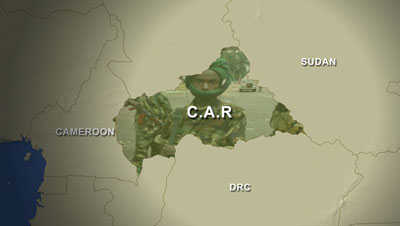
He claimed committee chairperson Jerome Maake had tried to make sure difficult questions about the deployment of SA National Defence Force (SANDF) troops to the Central African Republic (CAR) were suppressed.


“This was clearly an attempt by the ANC’s chief whip, Mathole Motshekga, who was also ominously present at the meeting, to politically manage the ‘CAR situation’ in Parliament.”  Maynier said the committee did not have the capacity to properly investigate the SANDF deployment to CAR.


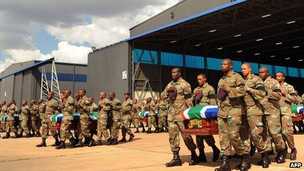
On March 23, 13 South African soldiers were killed and 27 wounded when Seleka rebel fighters attacked them near the CAR’s capital Bangui. Earlier, the Freedom Front Plus claimed an admission that South African troops were not prepared for attack in the CAR meant government had failed them.


“The acknowledgement by the Minister of Defence, Nosiviwe Mapisa-Nqakula, that the national defence force had neither been prepared for or expected the rebels to attack them in the CAR, confirms that the government had failed the defence force,” FF Plus  MP Pieter Groenewald said in a statement.


“Through this, the Minister acknowledges that there was insufficient support and in particular insufficient information support for the troops in the CAR.” This was after Mapisa-Nqakula conceded South African troops were not prepared to deal with an attack in the CAR. She suggested there were questions about the military intelligence provided to soldiers on the front-line.


“We never deployed to the CAR to wage a battle. We never anticipated a battle.” Groenewald said there were serious questions to be asked about military intelligence’s capability.


“One of these is how the Minister and President Jacob Zuma were incorrectly advised before the decision was taken to send troops to the CAR. The information was clearly not accurate and military intelligence has to take the responsibility for this,” he said.

CAR leader accepts regional transition road map


Image

BAINGUI – The rebel leader who seized power in Central African Republic and proclaimed himself president accepted on Thursday a call by regional leaders to speed up a transition to democracy, but could stay in office, his information minister said.

Michel Djotodia led thousands of rebel fighters of the Seleka coalition into the riverside capital of the mineral-rich country on March 24, toppling President Francois Bozize.

Facebook takes on Google


Image

CARLIFORNIA – Facebook Inc unveiled “Home” softwareon Thursday to place the world’s social network front and centre on Android users’ smartphones, a move that may divert users from Google Inc services and steal some of its rival’s momentum in the fast-growing mobile arena.

Its new family of apps will let users display mobile versions of their newsfeed and messages prominently on the home screens of a wide range of devices based on Google’s Android operating system, CEO Mark Zuckerberg told reporters.

Shares in Facebook climbed 2 percent to $26.83 (17.6 pounds) in the afternoon. Google stock was off 1.5 percent at $793.81.

“Why do we need to go into those apps in the first place to see what’s going on with those we care about?” Zuckerberg told the hundreds of reporters and industry executives gathered at Facebook’s Menlo Park campus.

“We want to bring all this content to the front.”

Facebook executives showed a new “chatheads” messaging service and “coverfeed” — both of which dominate users’ home screens and continuously feed messages, photos, status updates and other content from Facebook’s network.

“Home” brings the competition between the two Web superpowers to the mobile front, which is becoming many consumers’ primary conduit to the Internet. Facebook, the world’s largest social network, and Google, the dominant Internet search engine, are locked in battle for Internet users’ time online and for advertising dollars.

For Facebook, bolstering its mobile presence is critical. Nearly 70 percent of Facebook members used mobile devices such as smartphones and tablets to access its service at the end of 2012, and 157 million of Facebook’s roughly 1 billion users accessed the service solely on a mobile device.

The company has stepped up efforts to ensure that its revenue-generating ads can be viewed on mobile devices and Zuckerberg has said that the company’s engineers are now focused on creating “mobile-first experiences.”

Reports that Facebook was developing its own smartphone have sporadically appeared for years though Zuckerberg has shot them one down, saying that building a Facebook phone would be “the wrong strategy.”

With specialized software that adds a layer on top of Android, Facebook may get many of the benefits of having its own phone without the costs and risks of actually building a hardware device.