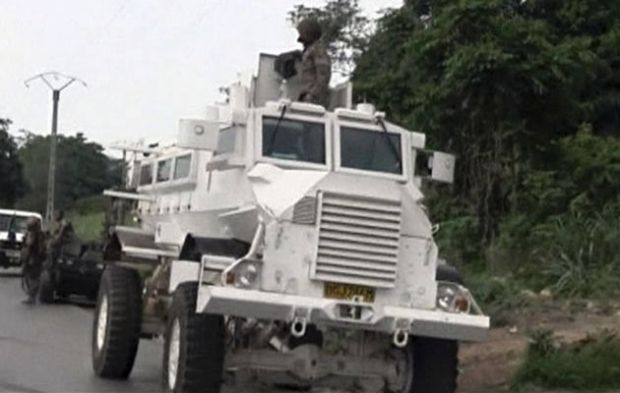
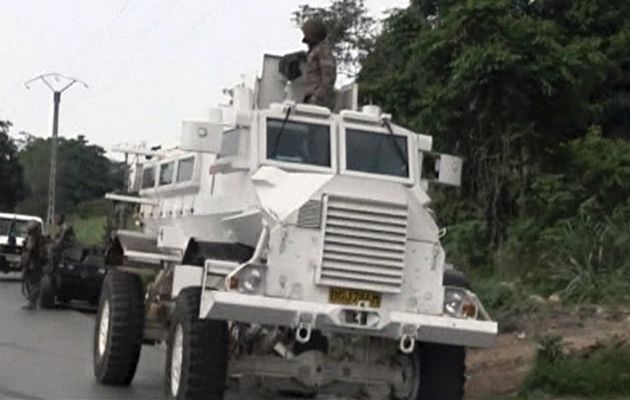
 Thirteen SA soldiers have been killed and 27 wounded during a clash with rebels in the Central African Republic, the SA National Defence Force said on Monday.
Thirteen SA soldiers have been killed and 27 wounded during a clash with rebels in the Central African Republic, the SA National Defence Force said on Monday.
“It was 200 of us against 3000 rebels,” SANDF chief General Solly Shoke said.
He said SANDF members were engaged in an high intensity battle that lasted for 13 hours.
“Our troops are in Central Africa. There is a relative truce for them. They are in position. They cannot run away or walk away,” Shoke, said.
“The safety of our people is paramount and we will use all means at our disposal,” Shoke said, “For us running away is not an option. That is a force we must be proud of.”
President Jacob Zuma announced the thirteen deaths earlier.
“We are deeply saddened by the events and developments in that country over the past 72 hours, which saw violence escalating and many innocent lives lost. We have confirmed that 13 of our brave soldiers who were committed to fighting for peace and stability in Africa fell in Bangui,” Zuma said at a briefing in Pretoria.
In December, Zuma sent Defence Minister Nosiviwe Mapisa-Nqakula to the Central African Republic to assess the security environment and general situation which was tense after the Seleka rebel coalition launched an armed campaign.
The report from that mission recommended an intervention, he said.
On January 2 2013, Zuma as the commander-in-chief authorised the deployment of up to 400 South African soldiers to CAR.
Only 200 of the soldiers had been sent at the time of the attack.
Zuma said South Africa and CAR had signed a military co-operation agreement in 2007. This was renewed for a further five years in December 2012.
That agreement entailed provision of military training to the CAR army and refurbishment of military infrastructure.
The deployment of SANDF troops in CAR was part of the country’s effort to contribute towards peace and stability in the region, Zuma said.
SANDF was tasked with building the capacity of the CAR defence force and help the CAR with the planning and implementation of the disarmament, demobilisation and reintegration process.
“On behalf of the government and the people of South Africa we would like to convey our sincere condolences to the bereaved families,” he said.
The just over 200 soldiers fought armed forces numbering over 1000 in a high tempo battle which lasted nine hours until the rebels raised a white flag and asked for a cease fire.
“South African soldiers inflicted heavy casualties among the attacking bandits,” he said.
Zuma said the South African government had not taken any decision to withdraw the army from CAR.
“We have not taken a decision to withdraw. You would in a sense appreciate that there existed an agreement between two countriesAnd our being there was related to the task that we were given. We defended our base successfullyThere has been no reason for us to leave. What we’ve been looking at is how do we enforce our forces, how do we ensure that there are no further casualties,” said Zuma.
“There is no reason for us to issue a command for withdrawal.”




 The Guardian