
BY Obakeng Maje
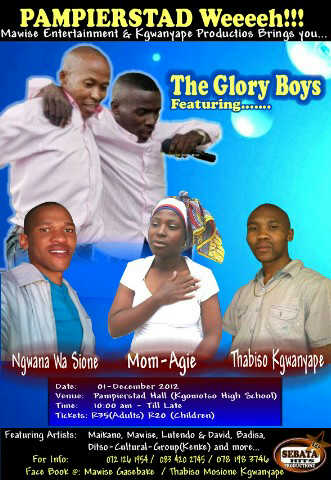
Pampierstad- Northern Cape province will be buzzing with much more fun this weekend when one of finest gospel groups touring the place.
The Glory Boys gospel group featuring many more gospel artists and others from various genre.
“We will be performing live and presenting soulful music to our fellowers” Mawise Gasebake said.
“We chose Kgomotso High school because I want to show message of support to the people of Kgomotso village and sorrounding areas” He added.
Mawise matriculated at Kgomotso High School and went on to embark on new adventures.
At its most basic level, gospel music is sacred music. It is a unique phenomenon of Africans which had its earliest iterations toward the end of the nineteenth century.
“Gospel is folk music which suggests that it and its secular counterparts are greatly influenced by each other” Mawise said with that angelic voice.
Just as much of the contemporary gospel music of today sounds like R & B and Hip-Hop, so did most of the early gospel music sound like the Blues.
Gospel, meaning “good news,” derived its name from it close connection with the gospels (books in the New Testament).
As we look at the common themes in the gospels of St. Matthew, St. Mark, St. Luke, and St. John, we find many references to God’s goodness and mercy
A Graspan-born artist said the gospel music will be combined with tradition.
One of the world renowned comedians Kenke originally from Botswana will also be part of the lineup.
Kenke affectionately remembered (from tswana comedy featuring Radijo) will grace the event with other traditional groups.
“Tickets are available and are selling fast like hot cakes,so please make sure you get yours and come and experience one of hottest festivals in Mzansi” Mawise added.
Tickets are already available and you can contact Mawise Gasebake on 0721261954/0834202745 or Thabiso Masione Kgwenyape on 0781983744.
In order to reach the widest possible audience, there are no “style” restrictions on gospel music; only the thematic content remains constant.
Coming out of an oral tradition, gospel music typically utilizes a great deal of repetition.
This is a carryover from the time when many post-Reconstruction blacks were unable to read. The repetition of the words allowed those who could not read the opportunity to participate in worship.
Gospel music over the centuries has ministered to the downtrodden and disenfranchised. To sing about a God who comes in the nick of time to deliver his people from uncomfortable circumstances is a consistent theme, which has been at the core of gospel music.
This music has been enjoyed for many decades and it continues to grow in its variety and sound.
Gospel music has a history which can be traced to the 18th century. During this time, hymns were lined and repeated in a call and response fashion and the Negro spirituals and work songs came on the scene. Because the enslaved Africans attended their masters’ worship services, the seventeenth century influences on Negro spirituals and work songs were traditional hymns the enslaved Africans heard in worship.
Worship services served several purposes; not only were they a means by which the Africans could be monitored, but they also served as a reinforcement of the slavery indoctrination.
Quite often readings were from St. Paul where made to being good servants and loving, obeying, and trusting one’s master. At this time it was also illegal for more than a handful of blacks to congregate without supervision.
This meant that the blacks were not free to worship on their own they had to attend worship services with their master.
At these services they would grow closer in their understanding of Christian doctrine and role that music played in that experience.
The worship music (hymns) of the whites masters became the backdrop for the music the enslaved Africans would use at their eventual worship meetings.
The unlawfulness of the blacks congregating did not keep them from secretly holding “campground” meetings. These meetings were typically held at a distance from the main house to assure discretion and avoid possible punishment. It was during these such meetings that “newer” renditions of traditional hymns were developed. It is often wondered how such creativity and beauty could have come out of such a dismal time. As we listen to gospel music today with its sometimes downtrodden themes, it continues to be curious how such beauty and richness can emanate from troubled times.
In the tradition of the black church, call and response in singing and in speaking has been and continues to be a foundation on which the gospel is delivered. Through this participatory delivery system beliefs are reinforced. There is an expectation that when there is agreement with either the spoken word or song because of either its content or its contexts that verbal affirmation will be given. Those who are witnessing, speaking, or singing are encouraged by the responses and those who are about to experience issues are empowered to be victorious.
Gospel music can stir many different emotions. The audience for this spiritually moving idiom continues to grow as do the types of venues where it can be heard. No longer bound to the walls of the American church, gospel music captures the creative and spiritual imaginations of increasing numbers of international audiences. For gospel singers and listeners, making a joyful noise unto the Lord is what the music is about and it invites the participation of all to come together, honor the past, look forward to the future, and through song, renew our faith.



 The Guardian