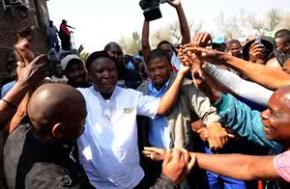
Johannesburg – As expelled ANC youth League leader Julius Malema grabs the spotlight of South Africa’s mining unrest with calls for wildcat stoppages, analysts on Wednesday said his rabble-rousing is dangerous – but also simply hot air.
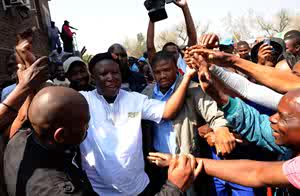
The self-styled champion of the poor has no official role after being expelled from the ruling African National Congress (ANC), but has taken his radical rhetoric from strife-hit mine to mine where he has been greeted as a rock-star by frustrated workers.
“It is quite dangerous in the sense that people are really clearly very frustrated,” said Lucy Holborn, research manager at the South African Institute of Race Relations, who said Malema had taken on celebrity status.
Tensions at the mines have deepened since a violent strike crippled London-listed Lonmin’s Marikana platinum mine, where 45 people have been killed – 34 of them shot dead by police – in a deadly stand-off over wage demands that have spread to the gold sector.
Union heads, mine bosses and President Jacob Zuma’s government have faced sharp criticism for giving the strategy-savvy Malema an opening to push his radical views in a country known for violent protests and strikes.
“It’s a situation where it’s so volatile that anybody coming along and firing up people, that he tends to do in these situations, can sweep people along,” said Holborn.
“When people are so frustrated, I think he can easily fire people up and it’s not necessarily about his power. It’s more a reflection of what people are feeling,” she added.
“That is why he is able to get so much support and get crowds so fired up. That feeling that the government actually either isn’t listening, doesn’t know or doesn’t care.”
Sporting his trademark beret and sunglasses, Malema has criss-crossed the country’s flashpoints to urge workers to render mines ungovernable, while taking political shots at his enemies in the ANC and white-owned companies.
The campaign has seen his face splashed across media around the world.
Endless media coverage
Yet while the strife-hit mines have turned into a battlefield for rival political and union factions, analysts warn against overblowing his powers or declaring a comeback for the mine-nationalisation maverick.
Analyst Steven Friedman of the University of Johannesburg cautioned that Malema was an opportunist whose bombastic speeches meet rapture but have little substance or real influence on labour relations at mines.
“This idea that he’s going to rush around the country making inflammatory speeches and people are going to be on strike is clearly false,” Friedman said, adding that the only impact was to attract “endless” media coverage.
“Marikana was several weeks ago now. If this guy was such a genius at rushing around the place getting people to go out onto the streets and to burn the place down, he would have been well on his way by now. And he isn’t.”
Since being booted from the ANC for ill-discipline, Malema has also lacked a constituency, with Friedman saying one of the “great myths” surrounding the ruling party’s former Youth League leader was that he had a giant following.
“The guy gets up and he says let’s bring the mines to a standstill and everybody writes inflammatory reports and agitated reports and nobody notices the obvious fact that mines are not at a standstill,” Friedman said.
This showed a large percentage miners “pay absolutely no attention to anything he says,” he added.
Hamadziripi Tamukamoyo, a researcher at the Institute of Security Studies, said Malema was a risk in terms of South Africa’s image.
“I think the political rhetoric he’s churning out is bad in terms of international investors, in terms of tourism. I think at an image level he is a risk and he needs to be called in,” he said.
Malema’s actions were playing into the hands of the anti-Zuma camp within the ANC who want him ousted as party chief later this year, Tamukamoyo said.
“I wouldn’t say he is dangerous but he has the ability, certainly with what is going on, to reconfigure the political landscape going towards” ANC elections in December, Tamukamoyo said.
But five years after Malema was called a kingmaker for bringing Zuma to the ANC’s helm, Tamukamoyo also warns against writing him off.
“I think we should not underestimate him as a politician. People laugh him off a lot and I think that’s dangerous in some way.”
No legitimacy
Meanwhile, Sapa reports that Presidency spokesperson Mac Maharaj has declined to comment on Malema’s assertion that South Africa is a “banana republic”.
“We won’t legitimise stories… by getting me or the presidency to comment. You don’t expect him [President Jacob Zuma] to comment on this,” Maharaj said on Wednesday.
“You [journalists] must pay the price and take responsibility for writing stories saying that South Africa is a banana republic because you might believe it.”
Earlier Malema told soldiers at the Lenasia Recreation Centre, south of Johannesburg, that South Africa was a “banana republic” that did not follow the rule of law.
“No one is above the law, not the military, not the presidency, and not Parliament. Every court decision must be respected. We must respect the courts, but the leadership of this banana republic disrespects the courts.”
He said the government had failed to adhere to court orders in three instances. It had not provided the Democratic Alliance with the evidence it wanted in the corruption case against President Jacob Zuma, had not delivered textbooks, and was not re-instating 1 100 soldiers put on special leave for protesting at the Union Buildings in 2009.
The country’s confidence in its leadership needed to be rebuilt.
“Your Commander-in-Chief [Zuma] is engaged in other things. You are a lesser priority. All of us are a lesser priority,” Malema said.
“I don’t know what is a priority to him, maybe getting married every year. He specialises on that one. Maybe that is what is going right for him.
“Here, children don’t have books, people in hospitals don’t have the necessary machines, they don’t have roads or clean water.”
Dictator
Malema repeated an earlier accusation that Zuma was a dictator.
“These are the symptoms of dictatorship, a political principle in the form of a president becoming more rich and rich, and those that he is leading becoming more poorer and poorer.”
He said he did not plan to de-stabilise the government.
“We are not planning any mutiny. We are not planning to remove any government undemocratically. Yes, we don’t love this leadership… we want to remove it democratically,” Malema said.
“We will never conspire with the soldiers, or anybody to engage in an illegal activity. Our government is leaderless. Your [the soldiers’] issue now is that from 2009 until now, your issue is not resolved.”
He said he had always told Zuma “votes were not cheap or free.
“Once president Zuma began to do other things, and move away from that mandate, that’s when we said this is something else.”
Malema criticised the way in which the problems at Lonmin’s platinum mine in Marikana, North West, had been handled.
“Government… instead of listening to workers in Marikana, is killing those workers… That is the government we have voted for.”
When he had sought to reassure the miners that they still had a future, he was called an opportunist, Malema said. People had only their voices and minds to fight “this barbaric regime under President Jacob Zuma”.
AFP


 The Guardian